Sunday, March 15, 2009

Moules à la bretonne: Breton mussles with oven-baked potato chips

first tried mussels when I was 6. On my last pre-school vacation in the Crimea, my Mom made friends with a Muscovite couple who spent their whole summer living in a tent on top of a seaside cliff. The husband had an aqualung that he used to swim to an underwater rock far in the open sea and pick wild mussels. Then they would cook them on a bonfire and wash it down with beer. I wasn't really impressed with this Robinson Crusoe culinary. The mussels on their own are too bland and the Muscovites tended to overcook them for food safety reasons.

It was much later in my life that I discovered how to cook mussels. It's a breeze. First make the taste base.Then steam well-washed mussels in it. As soon as the shells open, they are ready to serve!

More often than not I fix them à la marinière but this time I used a different recipe I picked up on my trip to Brittany: à la bretonne, the Breton way. There is a disagreement as per what constitutes Breton style. In St. Malô I had a bit of an argument with the proprietress of a brasserie we had lunch at. I wanted my Breton mussels aux lardons (with fried bacon specks) but she insisted aux oignons. We concurred however that there will be crème in it.

When back home, I dug myself into cookbooks and culinary encyclopaedia and discovered that there is a great variety of opinions on the subject. Some even claim that the recipe requires an andouille (chitterling suasage). Oh, c'mon! Why not stuff then a whole chicken in the pot and douse it with a gallon of cider, really, why not?

At any rate, I used my own impression of everything I saw of Breton cuisine in Brittany and created this wonderful recipe. It seems long but, in fact, is very simple and quick:
  1. Before you even get down to the mussels, pre-heat the oven to 220 degrees. If you use a gas oven, cover the vents with aluminium foil to prevent burning.
  2. Wash and cut 6-8 unpeeled potatoes into thick pieces (see the picture above).
  3. Mix a glug of olive oil, a smidgen of honey, a dash of aceto balsamico bianco, some freshly ground pepper and some sea salt.
  4. Drizzle the potatoes with the mix. Line on the oven grid making sure there is some enough space between them for the hot air.
  5. Wash well 2 kg mussels. De-beard, if necessary. Discard open ones.
  6. Peel and chop one onion.
  7. Melt a blob of butter in a big pot (I have a special one for mussels only, very handy and highly recommended!). Give it a nice grind of black pepper.
  8. Fry about 125 g smoked bacon and half the medium-sized onion until fragrant.
  9. Reduce the heat and add the rest of the onion. Sweat for a few minutes.
  10. Turn up the heat and add the mussels. Keep stirring to make sure all shells get exposed to the heat equally.
  11. Add a cup of single cream and a cup of white wine or cider. Wait until it boils, reduce the heat to minimum and allow to simmer for the alcohol to slowly evaporate. Stir the mussels to let them get drenched with the mix.
  12. Serve hot with the oven-baked potatoes.
At the bottom of the pot you have a most delicious seafood broth, unctuous, luscious and slightly smoky with a heady flavour of white wine or cider, whichever you choose to use. The potato chips come out lean and deliciously brown from the honey. You shall never want to go back to the deep-fried monstrosity any more.


Saturday, March 14, 2009

Winter treat: Apple cinnamon infusion tea

There is a strict 3PM caffeine curfew for me. I can't have even regular tea past that deadline else I stay awake with my eyes glowing in the dark until next morning. This is how I got into the habit of buying herbal teas wherever I go.

This apple cinnamon infusion is produced by Lipton but I saw it on sale only in France. It is a perfect companion to a warm blanket and a nice book on a cold winter evening.

Friday, March 13, 2009

Mapo dofu (麻婆豆腐): numbing hot Szechuan stew

Talking about Chinese cuisine is like talking about European cuisine ignoring the difference between, say, Norwegian, French, Polish and Greek food. In China, culinary varies enormously from region to region. On my first trip to China, I would move on to a new place every 2-3 days and I could never get the same food that I liked in the city before. A weirdly enjoyable kind of frustration.

There are eight main cuisines in China if we leave ethnic varieties like Tibetan or Uighur as well as urban fusion styles from Beijing or Shanghai out of the equation. One of the Eight Great Traditions is that of Sichuan (Szechuan).

It hails from the Southwest of China and is the spiciest of them all. There is even a special word for Szechuan kind of spiciness, numbing hot: 麻 (má). This comes from the use of
the so-called Szechuan pepper - dried flowers of a special tree that however is not related either to black pepper or chili peppers. They cause a mild numbing sensations to the taste buds.

Mapo dofu is perhaps the most famous Szechuan dish. I first tried it in Japan but my real encounter with it took place in Laos. The country's capital Vientiane is more of an oversized village with a handful of colonial French buildings. Laotian people love, nay, can only eat spicy food so the scraggy man from Chengdu who runs the only Szechuan restaurant in a thatched shack never runs out of customers.

Those were still my vegetarian days so after short negotiations in broken Chinese and Laotian he agreed to cook mapo tofu in front of me. Here I will share his recipe with you. It can be made either vegetarian or with meat.

The basic requirements for this dish are that it should be: numbing hot (麻), spicy hot (), hot temperature (烫), fresh (鲜), tender and soft (嫩), aromatic (香) (aromatic) and flaky (酥). This is achieved with a succession of the following.

  1. Cut a medium sized aubergine into longish (5-6 cm) slivers and put on a plate to dry.
  2. Cut a 400-500 g block of hard tofu into 1 cm cubes. Allow to drain and dry a bit.
  3. Heat a thick-bottomed pot or wok. Add 4 tbsp odourless vegetable oil and wait until it's hot.
  4. Add the tofu, gently stir and make sure it's all covered by oil.
  5. While the tofu is frying , peel and slice a few cloves of garlic.
  6. Once the tofu is blonde yellow, scoop it out in a bowl and add garlic to the oil.
  7. Once garlic is golden yellow, add half a teaspoonful of Szcechuan pepper, one tsp of white and one tsp of black sesame. Fry briefly until fragrant.
  8. (This is optional but I really love this touch: add 5-6 pre-soaked and julienned dried shiitake and fry until they start giving out flavour.)
  9. (Also optional but it gives the dish a smokey flvaour: add a nice dash of qingjiang vinegar and let it boil out.)
  10. Add 100 g minced meat: pork, veal or beef. Fry briefly until it's not red any more. Make sure it does not end up chunky. Vegetarians: use pre-soaked TSP (texturised soya protein) mince and soya sauce instead of fish sauce.
  11. Add the aubergines and fry for another 5 minutes. Add the tofu.
  12. Dissolve 2 tablespoonfuls corn starch in half a litre of water. Add into the pot and gently mix.
  13. Add 4 tablespoonful of doubanjiang and a glug of fish sauce and a glug of Chinese rice wine. Gently mix. Bring to boil, then reduce the heat.
  14. Add a handful of bean sprouts and half a handful of pre-soaked golden needles.
  15. Allow to simmer for 15-20 minutes more on a very low heat. Allow all the juices to dissolve and mix. It is even better to let the stew sit on the stove for an hour or so.
  16. Serve with freshly cooked rice.
It is very easy to make it veg(etari)an: use TSP (texturised soya protein) mince and soya sauce instead of fish sauce.

L
et Sa Ding Ding's Mantra accompany this fragrant meal:


Turkish sweets (Türk tatlılar)

he other day I was in Shepherd's Bush and happened upon an Afghani grocer. The owners have lived in Moscow in the mid-90s so we had a nice chat in Russian. They had all kinds of amazing stuff among which I recognised a familiar sight.

The translucent ones are chewy and called lokum. The speckled white blob is full of spices and called macun. They all are very sweet and taste great with black coffee.


Thursday, March 12, 2009

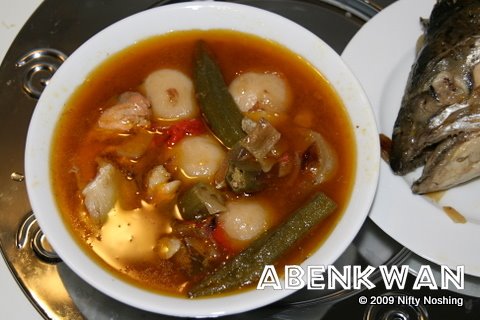
Abenkwan: Ghanaian palm nut soup with foufou

Abenkwan: Ghanaian palm nut soup with foufou recipeGive me head!" I point to a coolbox with freshly cut salmon heads. My fishmonger laughs. "What good is one, take two!" An excellent point. And I am so glad his English is not on the idiomatic level yet.

Even before I get down to cooking, I derive a huge kick from shopping for African ingredients in Brixton Market. Now I only need to buy some garden eggs and okra to fix abenkwan, Ghanaian palm nut soup. It is popular throughout West Africa and known as ngonya mosaka or mbanga in Cameroon, amiedi or obey-ekpo in Nigeria, moambé in the Congo, banga in Sierra Leone and nyembwe in Gabon.


The main ingredient that defines the flavour of abenkwan is palm nut oil. Without the oil you end up with a generic stew. It is squeezed out of boiled fruit of Elaeis guineensis. I go for convenience and buy ready-made one. It is imported from Ghana, so as authentic as it gets.

I have been fascinated with the cuisines of the Cradle of the Humankind ever since I heard a song by a New Yorikan poetess Dana Bryant. It was titled Food, an ode to home-made meals that trace their lineage back to "five thousand years of history on the Nigerian countryside". The tastes and flavours of the places I have never been to, what can be more exciting! So here we go, abenkwan soup with foufou! Yeeppie-ho!

The recipe is simple:
  1. Fry 3 tablespoonfuls of palm nut oil in a pan for about 10 minutes. Traditional recipe calls for a whole cup but here I prefer to give precedence to post-modern health-conscious trends.
  2. Add one chopped onion and one de-seeded chili and fry 10 minutes on medium heat.
  3. Add meat or fish that you use and fry it until fragrant.
  4. Add okra, garden eggs and tomatoes and stir-fry briefly.
  5. Pour cold water until it covers everything and bring to boil. Reduce heat and allow to simmer 10-15 more minutes. The traditional recipe requires a whole day of sitting on hot coals but I think in the olden days it was more about food safety.
  6. Mix foufou flour with water: half a cup flour with 3/4 cup water. Knead well. Make dough balls the size of a regular meat ball. Add to the simmering soup. Cook 5-8 more minutes.
It comes our robust, unctuous and flavourful. Thank you, Mama Afrika!


Here is some nice music to accompany this gorgeous meal:


Wednesday, March 11, 2009

Grilled Moroccan merguez (مرقاز) and couscous aux legumes

erguez is a harissa-flavoured Moroccan lamb sausage. In Amsterdam they are sold in the ubiquitous Moroccan butcher shops. To find one in London you need to go to Goldborne Road in North Kensington.

Lean and spicy, merguez does not need any additional seasoning. It tastes best grilled. Mind and do not overcook, it should stay pink and juicy inside.

The best accompaniment for merguez is couscous aux legumes, couscous with vegetables. You can go for the traditional Moroccan way of steaming it for hours on end in special earthenware, or do as I do and fix it in under 10 minutes with comparable results.
  1. Peel and slice a few cloves of garlic.
  2. Heat a thick-bottomed pot and add a nice glub of olive oil. When the oil is hot add the sliced garlic.
  3. Fry garlic until golden yellow and add chopped mint and coriander, a small bunch each. If you can't get hold of fresh herbs use dry ones. Allow the flavours to diffuse into the oil.
  4. Add any robust vegetables cut into bite-size chunks. I try to use one of each colour, for example, carrots, string beans and cauliflower. Tomatoes won't do because they are too gentle and I find that broccoli is too smelly and clashes with couscous. Quickly stir-fry for a couple of minutes.
  5. Add one cup of water and wait until it boils.
  6. Add 2 cups of couscous and stir well. You can use more couscous and water but the proportion must be the same to ensure that couscous comes out fluffy and not soggy.
  7. Reduce the heat to minimum and leave to steam for a 15-20 minutes.
  8. Serve with slowly roasted sultanas and pine nuts.

Sometimes I top merguez with tomato velouté flavoured with something simple and honest.
  1. Fry a few cloves of garlic, peeled and sliced, in a glub of olive oil until golden brown. Add any spice or herb you want at this stage, like smoked paprika powder or finely chopped coriander
  2. Add half a tablespoonful of corn starch and make sure it dissolves chunkless into the oil. Fry a short while.
  3. Add a tin of pizza tomatoes and reduce the heat. Stir well and allow to simmer for 10-15 minutes.
Chopped fresh coriander and sweet red onions give the whole dish a herby and crunchy zest.

Full-bodied Cahors comes from the Southwest of France. Russian Orthodox Church considers it to be the only type of wine good enough to represent Christ's blood in the Holy Eucharist. It is delightfully robust and goes gloriously with spicy merguez.

Tuesday, March 10, 2009

Cajun blackened salmon (saumon noirci)

Cajun blackened salmon (saumon noirci) discovered blackened salmon on my first trip to Texas. We were loitering in a shopping mall waiting on Aunt Lou to finish her shopping when I saw a sign for a Cajun restaurant. I simply had to check it out because you don't find that kind of food in the Old World. Blackened salmon became love at first bite.

Actually, there is a bit of tragic history behind this dish. French-speaking Acadian settlers in what we call now New Brunswick and Nova Scotia were forcefully evicted from their lands when the English took over in 1713. Some of them came fleeing to Texas. They held on to their traditions, and very importantly, their cuisine.

I admire its rustic sophistication. It combines simple ingredients with inventful spices and more advanced ways of cooking than you would expect from country folks. Although this recipe was invented in the 1980s by Paul Prudhomme, it was since wholeheartedly embraced as a truly Cajun dish.

  1. Cut a whole salmon half-an-inch thick. I use imperial measures here because 1.27cm would be too cumbersome to say.
  2. Melt about 100 g unsalted butter.
  3. Heat a cast iron frying pan very, very hot. I consider it ready for action when it starts smoking. I use a griddle skillet for the lovely sear marks.
  4. Dip salmon pieces in melted butter and sprinkle moderately with Tony Chachere's Cajun Frying Spice or in the mix of 1 tbsp powder garlic, 1 tbsp onion powder, 1 tbsp ground paprica, 1 tbsp black pepper and 1 tbsp white pepper.
  5. Yank salmon on the hot pan. Watch out as it can flare up. Fry about 1 minute on each side.
  6. Serve with fried or baked potatoes.
Here is a piece of traditional Cajun music to accompany this flavourful meal:

Monday, March 9, 2009

Spaghetti alla carbonara: it could not be easier!

n our culture of instant gratification it only seems sensible to buy ready-made food, be it soups, mains or even salad dressings. But many dishes are so easy to make and they come out so much fuller of taste and healthier, not to mention the emotional satisfaction. For example, I can't remember last time I bought mayonnaise, which all in all takes just under 5 minutes to fix.

However, this time I will introduce carbonara, which is basically bechamella based on bacon and onions. The chemical explanation of the following process is that
the flour makes the roux that will give the sauce its creaminess, while the bacon, onions and pepper will give the taste.
  1. Heat medium high a thick-bottomed pan. Add a nice glub of olive oil.
  2. Fry 125 g smoked bacon (I like it more than guanciale, but feel free to use whatever cured pig meat you want) and 2 chopped onions until golden brown. I use red ones but regular ones or shallots are just as fine. Some people add button mushrooms at this stage, which is supposed to be and Italo-American invention.
  3. Add 2 tablespoonfuls of wheat flour with a generous grind of black pepper and fry until it get nicely mixed with the oil. Make sure it gets fried a bit too otherwise the final product will smell doughy.
  4. If you substitute one tablespoonful of flour with one of corn starch the sauce will come out lighter and fluffier.
  5. Reduce the heat and add a glass of single cream and half a glass of white wine.
  6. Allow to simmer for about 20 minutes periodically stirring.
  7. At the end, the traditional recipe calls for mixing in an egg beaten with a pinch of salt and a wee dram of pecorino but I often skip it.
In the meantime, cook your favourite pasta al dente and - ta-da! -serve with your homemade carbonara.

The cherry blossoms on the side of the plate are real. It's spring in Brixton!

Saturday, March 7, 2009

Indonesian gado-gado: tempeh and veg salad with peanut sauce

his is what you can make with tempeh: gado-gado, a real Indonesian staple. It can be served as a main dish or a side. First time I tried it in the Sumatran hinterland. It dominated our lunch although there were many other dishes. The combination of crunchy, soft and chewy ingredients and the spicy-sweet aromatic sauce won me over in an instant. Once we stood up from the meal, the bill was served: 50 cent a head.

Gado-gado stands for "mix-mix" in Bahasa Indonesia so nearly anything goes into it. That said, certain things never do: e.g., tomatoes, croutons or ruccola. I prefer to improvise within the limits that Indonesian themselves find acceptable. This time I made it with
  • blanched pak choy,
  • blanched carrot,
  • a boiled egg,
  • fried tempeh (the crucial ingredient for me as it is so quintessentially Indonesian!)
  • raw or blanched bean sprouts.
You can also use
  • diced boiled potatoes,
  • raw or blanched lettuce,
  • blanched string beans,
  • fried onions,
  • blanched bean sprouts
without straying a bit from authenticity. Indonesians put them all in gado-gado.

Normally gado-gado is drenched with peanut sauce but I also have it with just sambal manis, as on the picture. Instant peanut sauce, sambal pecel, as in the picture below is available in most ethnic groceries in Amsterdam but I yet have to track it down in London. You only need to dissolve it in hot water or coconut milk. I also add some crushed lemon grass, shredded kaffir lime leaves and galangal powder. Making your own is not complicated but you need to line up all the right ingredients. I will post the recipe when I get around to that (feel free to prod me!).

Serve gado-gado with freshly cooked long-grain rice.

+++
Spruce up your diet with my vegetarian recipes from all over the world!


Café in the Crypt @ St.Martin-in-the-Fields: dining on gravestones

ired of the same ole? Why not try dining on gravestones in Central London then? Quite revealingly named Café in the Crypt at St.Martin-in-the-Fields Church offers unpretentious English classics in a basement cafeteria. This site has been a burial ground since at least 410 but the dining tables here stand on gravestones from more recent times. Weirdly enough, not a single punter seems to mind.

Olga and yours truly had there their pre-theatre dinner. Olga is fasting so she barely nibbled on some couscous. I recommend everyone to take her out: won't cost you the earth and she's delightful company! I had a ball with Today's Special: beef and turnip stew, baked rosemary potatoes and boiled red cabbage (£8.50). There is no going about the fact that traditional English food tends to be rather mucky but here good quality ingredients have redeemed it. The presentation may not have been top notch but the beef was tender, the turnips -
flavourful, the potatoes - as tasty as they look on the picture and the cabbage was, well, boiled cabbage.

My starter, bean, potato and thyme soup was just the right degree of peppery and quite aromatic considered that it came from a pot that is kept warm the whole day. For the afters, I had a princely dollop of apple pudding with a ladleful of custard. The pudding crust was delightfully crunchy, the puréed apples - with just a hint of cinnamon and the custard - exactly the right degree of sweetness. Despite the volume it did not end up lying heavy on my stomach. The pudding and soup combo is priced at £5.65.

To wash it all down, we had Victorian Lemonade (a zesty concoction of ginger and lemon) and Apple and Beet Drink (an innocently bland light crimson water). Great thing about this place is that great classical music is just two flights of stairs away. I am very picky and hard to please when it comes to music but tonight's Vivaldi seemed highly conducive of good digestion!

Pro's: Great location, freaky design twist (memento the gravestones!).
Con's: The smell of boiled cabbage pervades EVERYTHING.
Summary: Simple and honest food but expect nothing fancy.

Café in the Crypt, St. Martin-in-the-Fields, Duncannon Street, London WC2N 4JJ

Friday, March 6, 2009

Unagidon (うなぎ丼): Japanese summer survival tool

Japanese summer is relentless, especially in the cities. The concrete jungle absorbs the sun heat while millions of air-conditioners pump out typhoons of hot area into the streets. It is in fact so bad that it is a national custom to send "midsummer heat fatigue" (natsubate) greeting cards inquiring how others are managing.

Unagi-don (うなぎ丼), grilled eel fillets served on top of hot rice, is supposed to provide strength to withstand the exhausting heat. There is even a special day, Doyou no Ushi no Hi, when its consumption is deemed especially beneficial.

Whether a commercial gimmick or Oriental wisdom, unagi-don is a superbly delicious dish. In fact, I enjoy it even more in winter. I cook it the Kansai way: cutting the eel's belly and basting the grilling fillets with tare made of sake, mirin and shoyu. Unlike epicurean Kansai merchants, stuck-up Edo (Tokyo) samurais hated that practice as it reminded them of seppuku (commonly and incorrectly known as harakiri).

The recipe is really simple:
  1. If you have a whole eel: cut off the head, gut it, cut it in 6-7 cm pieces and removed the spine. Don't worry about the small bones.
  2. Mix shoyu, mirin and sake half a cup each. Marinate the filets for at least an hour.
  3. Grill the filets, regularly turning them over and basting with the marinade. Depending on your grill it takes up to 20-30 minutes. Alternatively, use a grill skillet.
  4. Serve on top of freshly cooked Japanese rice. For the authentic taste only use short-grained japonica, long-grained jasmin and basmati just won't taste right.
Japanese sake or beer goes well with unagi-don. Dry white wine might be good as well but I find it a sacrilege and never even try but why should it stop you?

One of my favourite Japanese songs. Technically it is Okinawa-flavoured but it won't clash with the taste of unagi-don.


Thursday, March 5, 2009

Ho mok talay: a super fancy Thai omellete

hai food is never too complicated to cook nor is it awfully time-consuming. It is down to the right combinations of fresh ingredients to impress the eater.

The list of what goes into ho mok talay (ห่อหมกทะเล) may sound intimidating to the uninitiated, but it is really a coconut-milk based seafood omelette with Thai herbs and spices. And a great one at that!

In Thailand they normally steam it in banana leave
boxes, but I couldn't be arsed with such dainties. I just slow-cook it in a huge pig iron wok with just the same result! The quantities of the ingredients really depend on how much of ho mok you want to end up. So there you go:

  1. Heat a nice thick-bottomed wok. Oil it with odourless vegetable oil.
  2. Chop half a bunch of pak bung and line the wok with it.
  3. Add seafood and white filleted fish. I use shrimp, squid, mussels, clams, baby octopuses (octopussies?) and whatever gifts of the deep brine I can lay hold of.
  4. Beat eggs and mix them with coconut milk and some corn starch: about 2 eggs and a tablespoonful of starch per tin. Two tins and 4 eggs fill up my huge wok.
  5. Add: sliced galangal root (about 2 inches), 6-8 finely shredded kaffir lime leaves, a tablespoonful of ground kurkuma (turmeric), 2 stalks of lemon grass (chopped) and 1-2 chopped chilies (ho mok is not supposed to come out too spicy!), 3 tablespoonfuls of crushed peanuts.
  6. Pour the mixture into the wok and make sure it goes al the way through the fish, seafood and pak bung.
  7. Cover with a lid and cook on low fire until it achieves the texture of omelette.
  8. Serve with freshly steamed jasmine rice!

The technology is the same with those banana leave boxes, but then you steam them for 15-20 minutes.


++++++

Thai language school and translation agency in Bangkok, Thailand offering Thai, Chinese, English, Japanese, Russian and Laotian (Lao, Isarn, Isaan) language courses.

Tuesday, March 3, 2009

Nothing cookin': Japanese hiyayakko

his simple dish takes no cooking at all. It is a variation of hiyayakko (冷奴)- a classic Japanese beer snack.

Raw silken tofu is simply garnished with wakame seaweed and ever so lightly poached enokitake mushrooms.

I make the dressing out of equal parts of:
  • soya sauce
  • sake
  • katsuobushi extract and
  • lime juice (because I can't find yuzu that the original recipe requires).
An itsy drop of wasabi adds a pleasant zesty tone. That's it. Nothing cookin', really.

Veg(etari)ans: skip the katsuobushi extract, use konbu or shiitake.

My nostalgic grub: ham and cucumber sandwich

When I was growing up, sandwich was a piece of bread with butter and a slice of sausage. While my peers gleefully munched on theirs, I was always appalled at such lowliness and lack of finesse. I always knew there is more to sandwiches than slabs of unadulterated cholesterol and meat of dubious provenance stuffed in pig's intestines. But I seemed to be the only one around with that opinion.

Paper-thin salty ham and fresh-smelling cucumber slices on earthy rye bread (
sumuštinis su kumpiu ir agurku) washed down with powerfully aromatic espresso in a café at the Vilnius Railway Station - this is my strongest memory of my first parents-free vacation at 15. These days I know more far-fetched ways to fancify a peace of bread but I still keep trying to recreate that feeling of a newly found freedom in a vaguely foreign city. I just use better ingredients.

Swedish knäckerbröd bread with sesame seeds, smoked Schwartzwälder ham, French mustard with unripe black peppers and - it's never the same without them - slices of cucumber and three umlauts!


Thai durian does not smell!

The king of fruit, durian (ทุเรียน), is my favourite ever. Thanks to globalisation now you can buy it in many ethnic groceries even in the West. In Amsterdam it's to be found in Chinatown, in London - at Brixton Market.

It's got a bad rep because of its alleged pungent odour but that is so not true. The real culprit is the cheaper yellow-fleshed variety common in Malaysia in Indonesia. In Thailand it is known as Chani and generally looked down upon. It smells indeed rank and does not taste as good as the superior type, the more expensive Mong Thong, the Golden Pillow.

Its creamy flesh reminds of fruity custard but, really, is just incomparable to anything else. It is delightfully sweet but the Thais can't seem to have enough, they eat it with sweetened sticky rice boiled in coconut milk!

Recently I have seen writings by gormless individuals trying to bust the "myth" that combining durian with alcohol is dangerous. Whatever your "research" may say, I myself have had a near-death experience when I gulped down a can of beer half an hour after gorging on a durian. That was one of the most unpleasant physical experiences. Despite it was 30 degrees in the street, I was covered in sticky cold sweat. I felt sudden weakness like I was about to faint and there was nothing to do about it because both the fruit and alcohol had already been in the system. Creepy. So NEVER mix alcohol and durian!

Monday, March 2, 2009

Breton cotriade: poor French fisherman's delight

Breton cotriade is basically the same as Russian ukha: white sea fish stewed with potatoes and onions. In Russia most of time it is made of fresh water fish, while in Brittany, naturally, of the catch from the brine.

The only condiments being sea salt and coarsely ground pepper, this dish brings out the best of the flavour in fish. It is very simple yet exquisitely delicious.

The recipe couldn't be simpler:

  1. Peel and cut potatoes, let them dry a bit (this way they will less likley crumble).
  2. Peel and chop an onion.
  3. (Skip this part for the Russian ukha!) Fry a few stripes of bacon in a pot. Add the onion and cook until soft.
  4. Add cold water and put the potatoes (and raw onions for ukha), bring to boil, then add fish.
  5. Keep skimming the froth that comes up to the surface.
  6. Add salt and pepper to taste. This comes out even better when you use the heads of big fish.

Venison sausages with juniper sauce

cooked the venison sausages I bought at the Southwark Slow Food Festival the best way I know how: with juniper sauce. It is a variation of the classic bourguignonne for game dishes. Juniper berries give that foresty, coniferous fragrance that goes well with the powerful flavour of venison, boar or pheasant. Potatoes boiled in jackets are there just to soak in the juices and aid the enjoyment of two major flavours.

Sunday, March 1, 2009

Simplest, quickest and yet great spaghetti dinner

All best things in life are free, they say. Well, some may not be free but they can still be very cheap.

Like this amazing spaghetti recipe: a family dinner for under a pound, how about that? I learnt it from my Italian friend Luisa. Once we were stuck late at night at home with a few mouths to feed and a virtually empty fridge. The kitchen cupboard was not exactly full too (see, this was not my home!) Luisa came to rescue and everyone was full and happy in just 20 minutes.
  1. Boil a pack of good quality spaghetti al dente.
  2. Peel and slice a head of garlic.
  3. Toast garlic golden brown in generous amount of olive oil.
  4. Mix the garlic and oil into the cooked spaghetti.
  5. Serve with grated parmiggiano or cheddar.
I serve it with some chopped sun-dried tomatoes and salted anchovies if I have those, but that is optional. Here the best of Italian cooking comes forward: simplicity, healthiness, taste based on the quality of ingredients and time-proven combinations.

I am really tempted to predicts that this recipe, if ever noticed, may come in vogue in the forthcoming months.