Wednesday, August 4, 2010

Japanese yuzu dressing recipe (柚子ドレッシング)

Yuzu is an East Asian citrus fruit whose fresh aroma can spruce up the most boring dish. One way to make use of its invigorating flavour is in a salad dressing. Unless your local Asian grocer stocks fresh fruit, feel free to substitute it with a more readily available yuzu vinegar. Lime is an okay substitute but the flavour just won't be the same.
  • 2 tbsps yuzu juice or yuzu vinegar
  • 2 tbsps soy sauce
  • 1 tbsp mirin
  • optional: 4 tbsps vegetable oil - plain sunflower or, for an extra punch, sesame
Shake the ingredients vigorously in a jar until completely homogeneous. Pour over salad right before serving.

Friday, July 30, 2010

Tyulka: Southern Russian beer delight (тюлька)

Tyulka is a sprat-like fish in the Black Sea that, when dried, or rather cured in dry air, turns into veritable vials of most fragrant fish oil and delightfully crunchy meat. A perfect companion for cold beer, it is sold all around Southern Russia, although it is harder to find in Moscow. On the Canaries, a saltier and drier version is called pejines.

Wednesday, July 28, 2010

Puttanesca africana: global fusion cuisine

Quite unbeknownst to me, my cooking patterns have evolved to embrace a most spectacular variety of world cuisines - all too oft mixed in a single dish. I realised that when fixing my spaghetti lunch today. As I sautéed garlic and onions in olive oil for puttanesca, I added Thai anchovies and, in lieu of old boring salt, Vietnamese fish sauce - it gives food a more pronounced, deeper flavour. Then I mixed in a pinch of finely chopped Nigerian peppers, which made me think of an Italian puttana feeling sore after a night of heavy African sailor loving: when used in moderation, the peppers leave exactly that pleasantly burning sensation in your bodily orifices as a lot of sexual rubbing does. They also give that drool-invoking savoury flavour so prized in Africa and the Caribbean.

Freshly picked basil leaves and a few shavings of hard cheese felt just right with this intense salty-spicy sauce.

The recipe:
  1. Peel and finely chop three red onions and half a head of garlic.
  2. Heat a frying pan well, pour a generous glug of olive oil and grind some black pepper into it.
  3. When the pepper starts giving out a flavor, add first the garlic and then 10-12 dried Thai anchovies. When both golden brown, add the onions, sauté until all golden brown, then add a pinch of finely chopped Nigerian peppers and fish sauce to taste.
  4. Tip a tin of chopped tomatoes and half a cup of red wine and mix well.
  5. Allow to simmer on a very low fire for 10-15 minutes.
  6. Serve with fresh herbs - parsley, sage, thyme or basil - and a few shavings of mature cheese.

Monday, July 26, 2010

Monday 27th, 2010: Indian lunch, lobster dinner

Indian Lunch:
  • Tikka Masala Chicken,
  • Madras Chicken,
  • Masala Dal,
  • Biryani Rice,
  • orange juice.
Lobster dinner:
  • Turkish chicken and almond soup (Bademli ve Terbiyeli Tavuk Çorbası)
  • chestnut mushroom oven-baked with truffle oil and goat cheese,
  • salad du jardin with lime-wasabi dressing,
  • boiled lobster with dill-butter dip
  • watermelon
  • 2006 Chardonnay-Vermentinu-Muscat, Vin de Pays de l'Ile de Beaute
  • Stowell's Chilean Sauvignon Blanc


Je vous remerci pour notre pain quotidien: Monday 27th, 2010.

Sunday, July 25, 2010

Liquid smoke - best since sliced bread

iquid smoke is possibly the greatest invention after sliced bread. As it is filtered a few times, it is supposed to be healthier than your plain old smoked products. Even more importantly, it lends that lovely extra flavour t your steaks and whatever you choose to bake in your oven creating a perfect illusion of something barbequed on charcoals. Use sparingly and towards the end of cooking to retain its intensity and richness.

Monday, July 5, 2010

Whitstable oysters: Britain's best

They say that what goes around, comes around. That's true, but every time the game level is up.

Friday, July 2, 2010

Sunday (Up)Market World Food Fair

unday Up-Market World Food Festival for me is perhaps what a brothel is for a sex addict. From Brazilian to Tibetan and from Greek to Ethiopian, every weekend an indoor parking space in Brick Lane turns into a fiesta of world cuisine at affordable prices. I could wallow my way through the rows of steaming pans and drown myself in a pot of Thai curry, like Duke of Clarence in a barrel of Malmsey wine.


Pro's: Choice. Price.
Con's: No sitting facilities. Open only on weekends until 5PM.
In a nutshell: All authentic local foods of the world in one place.

Address: The Old Truman Brewery, 91 Brick Lanee, E1 6QL 


Tuesday, June 15, 2010

Gigot d'agneau: perfect roast leg of lamb recipe

Once you've bought yourself a nice (organic, free-range) leg of lamb, you are entrusted the responsibility not to spoil it. It's a gift of nature that takes a lot of time and effort to mature, take very good care of it. Here are the ground rules you need to abide:
  1. If it is frozen, defrost is slowly: for example, in the fridge overnight. If you are in a rush, submerge it in cold water. This may make it lose some flavour though.
  2. Easy on spice: sea salt, freshly ground black pepper, sliced garlic and one herb should suffice.
  3. Best herbs to go with lamb are: mint, hyssop, rosemary, thyme.
  4. Poke the leg with a sharp knife and make sure the herbs, salt, pepper and garlic end up in each hole.
  5. Giving your lamb a light coat of vegetable oil will save it from burning and keep the juices inside.
  6. Pre-heat the oven to 230 degrees and bake the lamb for 20 minutes. This will also help to seal the juices inside. Make sure it does not burn by covering the top with a piece of aluminium foil.
  7. Continue at 200 degrees for another 30-50 minutes depending on the size. Different ovens work differently so you really need to figure the right timing out on your own.
  8. It's better to undercook than to overcook: well done lamb gets chewy and loses it flavour. Medium rare - as on the picture above - is the best
  9. PLEASE: do not use ketchup, brown sauce and Tabasco. Those are designed to conceal the poor taste of low quality produce. Your gigot d'agneau deserves better!
  10. Roast veggies, particularly roots, are lamb's best companions. You can put a tray with sliced potatoes, parsnips, root celery, burdock, Jerusalem artichokes, pumpkin etc. underneath your leg of lamb so it gathers all the lovely juices dripping down.

Monday, June 14, 2010

Rodizio Rico: Brazilian churrascaria@Islington

One of the most overused words in food writing is succulent. As protein-based life, we enjoy putting in us everything that approximates our inherent water content of 80%, hence the everlasting appeal of juicy cocks and sappy strawbs. The deepest layers of our ancestral collective memory dating from the arid Rift Valley's hominids compel us to crave anything evoking moisture.

It is no wonder then that Rodizio Rico, an all-you-can-eat Brazilian churrascaria (grill) restaurant on Islington Upper Street rides on this bandwagon too. Succulent is how they describe their fare. Unfortunately, what its passadors (meat carvers plying between the tables with skewerfuls of grilled animal pieces) offer has little backing to this claim. For £22.50 a head, it sure is hard to offer no-time-limit all-you-can-eat rib-eye steaks to everyone, so what you get is silverside (primarily used for corned beef Down Under), rump cover and chicken gizzards.

I am quite used to ordering my steak medium rare to have it medium but here there was no chance to employ that trick: the best I could get was half a notch before well done. Whether it could be down to the Health and Safety tyranny or something else I will never know.

The salad buffet is very New World, being large and colourful. It features deep-fried Middle Eastern pieces, bean-based Brazilian starters and stews, generic "international" salads and a lot of French fries. All of those had that unmistakeable imprint of the contempt a hard-nosed carnivore has for plant-based food. Dry falafels, sour olives, bland couscous, mayonnaise-heavy coleslaw, etc.: I made the effort to try them all but there was none that I would have another helping of.

I may sound pissy but you have to go there to believe the queues. We had to wait at the bar long enough to polish off a whole bottle of wine despite we had a reservation. My American friends were naturally outraged at this manifestation of the tempo brasileiro spirit. As always, I was the one who insisted on waiting patiently and giving the place a chance but this time around I was wrong.

Pro's: Easy to order as there's no menu.
Con's: Even a reservation won't save you from queueing. Airfield noise levels.
In a nutshell: Good place for a major protein re-fuel if you are not awfully fussy about your meat.

Rodizio Rico
77-78 Islington Upper Street
London N1 0NU

Wednesday, June 9, 2010

Kopparberg: Swedish pear cider

I love picnics. There's hardly a better drink for dining on the grass than cider and perry. Festively fizzy, naturally aromatic and with just enough alcohol content to get your delightfully buzzed but not inebriated. Up until recently, I had to wait to go to France to buy cider and perry there. The English varieties fall into the category of working-class booze and seem but a cheap flavourless alternative to beer.

However, Tesco's on High Street Kensington, a far cry from the Brixton branch, which mostly competes with Iceland in providing the essential components of the "White trash diet",
presented me with a lovely discovery. Kopparberg cider comes made from pears or apples and can also be alcohol-free. It could be down to Sweden being ruled by a bunch of Frenchies, their royal family, but Kopparberg tastes and smells as if it hails from Normandy. At 2.19 a small bottle it is not a bargain compared to the excellent champagne-sized 78-cent cider at Auchan but it sure can tide me over until my next grocery trip to Lille.


Tuesday, June 8, 2010

Scotch egg

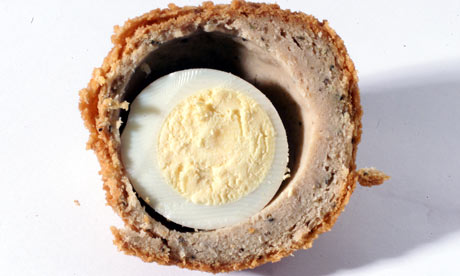
Here they are in front of me like a pair of gigantic shaven and tanned highlander testicles. Despite the name, the blessed idea to deep-fry boiled eggs covered in sausage mince and breadcrumbs occurred to some English people at London's posh department store Fortnum & Mason. We can only guess what combination of circumstances and train of thought had led to this invention but these days Scotch eggs are a popular party snack from Minnesota to Jaipur and from Inverness to Lagos.

For some unfathomable reason, these days it is widely considered the ultimate picnic food. It is also a permanent fixture on gastropub menus. The picture below by Guardian's David Sillitoe may explain my incredulity about the whole Scotch egg hoopla.

Tuesday, June 1, 2010

Bamboula@Brixton: Jamaican restaurant review

What are you taking pictures of?!!

An enraged Jamaican man pounces on us as I'm taking snapshots of our long-awaited dinner. The proprietor, as it turns out, works himself in a scary frenzy as the private party he is entertaining across the room from us are apparently nervous about any photographic euqipment deployed anywhere close to them. Perhaps, balacalvas would be a good solution for their phobia.

In the meantime, our dinner keeps arriving, one dish at a time.


We have long meant to visit this restaurant located right in front of the favourite haunt of Brixton's feral teenagers, across the road from the Lambeth Town Hall, but some other chow-hound opportunity would have always turned up.


About an hour before the closing time, warnings started coming, like in a vintage sci-fi movie where a mechanic female voice advises everyone to evacuate before the explosion. Never mind the


As one for the road, we get not even a sorry when the perfectly coiffed cashier chick shortchanges us of 20 quid. Like, big deal, mon.

Pro's: Good-tasting food, some less known Jamaican dishes.
Con's: Smallish portions. Rude-boi style customer service. Waitresses seemingly unaware of the fact of their gainful employment, while totally engrossed in "keeping it real" and working on their "street credibility".
In a nutshell: With so many other alternatives for West Indian fare in Brixton, give it a miss.

Wednesday, May 26, 2010

Chez Liline: pelagic perfection, London restaurant review

Good seafood restaurants are hard to to come by in the cities: the supply lines need to be quick to maintain freshness, the paramount attribute of this delicate product. But imagine if a fishmonger was also a seafood restaurant proprietor. Someone who deals in fish would also cook it and serve it. And if that someone was from a tropical island amidst the Indian Ocean, with a passion for flavours and fine cuisine.

Such a place does exist in London in, of all places, Finsbury Park. Chez Liline is a Mauritian restaurant, serving food from that peculiar place where such diverse cultures as French, African, Indian and Chinese blend into something quite delectable. Imagine black beans, chillis and fresh basil adorning one dish: yummm, indeed!

Every time we go there with my friends Dusko and Mack, we get the Chef's Menu, the FRench version of the Japanese omakase, where you let the chef decide what is good for you and what is best today.

Everything comes freshly cooked from the kitchen, sizzling ina cloud of aromatic vapours. The variation is not large, it's samish combinations and ingredients every time, what matters is the perfection to which everything is cooked!

The starters are different kind of seafood - mussels, scallops, baby squid and shrimp stir-fried with sauce: spicy blackbean, butter.

Thursday, May 20, 2010

Kale, a.k.a. boerenkool or grunkohlessen: back to roots!

Kale is one of the classic European staple vegetables that Northern European peasants used to sustain on before potatoes and tomatoes and other exotic lovelies became normal.

It is experiencing a sort of nostalgia-driven fad revival in Holland and Germany, when city dwellers have become removed enough from the realities of rustic life to long for the good ole days of hearty healthy food when "things were simple and straightforward".

Kale is indeed a very wholesome one, apparently full of calcium and fibre. The basic recipe is to steam it, chop it and fold into mash potatoes. This is what is sold in Holland as the cheapest one in Albert Heijn's range of infamously insipid steamed lunch packs.

Monday, May 17, 2010

Fini ratluk: Serbian hand-made Turkish delight

A vestige of the Turkish rule in Serbia: hand-made Turkish delight, pistachio flavoured. A nice souvenir straight from Belgrade for a curious foodie like your truly.

Saturday, May 15, 2010

And luxury for all: Marks & Spencer venison sausages

I have had more venison sausages since I moved to London in 2008 than in my entire life. First I saw them at the enlightened Slow Food Festival on the Southbank: aimed at the kind of crowd that regularly hangs out at the Royal Festival Hall, with prices to match. Now the commoditification of luxury products has brought game meat to the shelves of Marks & Spencer. Mind you, marked down! Four quid fifty for two boxes, 12 venison sausages. Is the right spelling surely not Marx and Spencer? Granted, working classes don't shop at Marks and Sparks but wealth-trickling needs to starts somewhere. Now it is down to persuading the masses to stop buying the similarly priced frozen toilet-paper-and-emulsifiers Cumberland sausages and switch to game, Argentine red and silver cutlery. Next logical step perhaps would be licensing the denizens of Woolwich for fox-hunt.

Serving suggestion: grilled, with garden salad and finocchio alla griglia. If you have the patience, sauté chopped shallots in the sausage juices, add a few juniper berries and red wine, simmer until alcohol evaporates.

Wednesday, May 12, 2010

Bitter gourd, goya, cerasee, karela: it's all actually one thing

Truly omnivorous that I am, there are very few restrictions when it comes to food, as long as it is nicely cooked. All edible carbon matter on this planet is a gift from God not to be taken for granted. My very few no-no's cover probably just steaks from cute animals like koalas and guinea pigs . Otherwise nothing else is barred. Bitter melon, however, is something I don't suffer gladly. I force myself to eat it because it is supposed to be so good for health (like most other health foods). The ridiculously long average life span on Okinawa, which beats even that in mainland Japan, is routinely attributed to the high consumption levels of goya, as it is known in Japanese.

The most common way to cook it is to remove the scathingly bitter peel and seeds and stuff the remaining flesh with mince, tofu and rice. This brings down the bitterness to a more tolerable level but it still tastes like somebody has accidentally spilt a pack of quinine into the pot.

As if to try to make life in the Caribbean less sweet, Jamaicans make tea out of cerasee. With every sip you need to remind yourself of its alleged health benefits, de-pimpling the skin being one of them.

Tuesday, May 11, 2010

Ras el-hanout: the head of the shop

ayer upon layer of ground spices get scooped up and mixed to zhush up tagines, the ubiquitous, and otherwise not that exciting, North African meat-and-veg stews. Apparently, there is no set recipe and each shop and housewife make their own mix. So, basically, it's just all spices you could get hold of, arranged aesthetically.