Showing posts with label African. Show all posts

Wednesday, December 2, 2015

Three continents in a pan: stir-fried spinach with chorizo and onions

Considering what I stash in my cupboards, it's no wonder most of my cooking is some kind of fusion. Whether 'improving' French stews with Thai fish sauce or spiking hommous with dried lime powder, the Post-Modern culinary pastiche is the order of the day.

Today's lunch was whipped up at the epistemic crossroads of Thai, Spanish and West African cuisines: the classic Thai phat phak fai daeng was made with Asturian chorizo as well as African spinach, onions and Scottish bonnet peppers, proving a very happy marriage.
  1. Slowly saute a lot of crushed garlic with a tad of finely chopped Scottish bonnet pepper.
  2. Add sliced chorizo and fry on a medium fir until it makes the oil red.
  3. Add some chopped tomatoes and red African onions, fry until the onions are soft.
  4. Add a lot of chopped African spinach (it's more robust and sweeter than the regular one) and fold into the mixture. Fry until the spinach retain just a bit of crunch.
  5. Season with Thai fish sauce.

  6. Serve with steamed rice.


Saturday, October 9, 2010

Culinary espionage: Mrs. Mahmoud's secret couscous recipe

There is this Sudanese lady in my apartment block who exudes motherly kindness as she glides around unhurriedly in resplendent multi-layered robes. A year ago I was sitting at my Nigerian neighbour's place having a nice friendly banter, trying, as usual, to outshout a Nigerian music channel on TV and two simultaneous mobile phone conversations, when she popped by with a big bundle in her hands. No, that was not an illegitimate baby, but a large pan wrapped in towels to keep it warm. Inside was the most aromatic and scrumptious couscous that ever hit my nostrils or touched my taste buds.

Let's be honest with ourselves, couscous may be a hip food these days, but most of times it tastes like wet sand and smells like old clothes. Even when cooked at home, following the instructions on the package blindly: "boil water, add couscous, let it sit on the stove for a while", results in lumpy gunk none more illustrious than the anaemic supermarket variety.

That is why Mrs. Mahmoud's couscous was a revelation. I had to know how she managed to turn something so bland and unexciting into a fiesta of taste buds titillation. However, all my subsequent attempts to elicit the recipe from her were to no avail. Not she was unfriendly or secretive. She was too shy.

I had had it before and I still get it all the time. When I ask my African neighbours for recipes the immediate reaction is: 'Why would a White guy ever want to cook African food?' 'Well, because it tastes so blooming good!
' Any request to teach me a Yoruba phrase or explain the meaning of different ways of tying female headgear are met with the same kind of disbelief and cultural self-denial. The roots of this deeply seated sense of unworthiness are brilliantly explored in Shohat and Stam's brilliant Unthinking Eurocentrism, but I digress.


In short, I had no other option but to try and crack the recipe myself. After a few progressively successful attempts and a lot of spying on African ladies shopping in Brixton market, I have finally managed to get the taste and flavour exactly like that Mrs. Mahmoud's. So here how it goes.

Mrs. Mahmoud's secret couscous recipe:
  1. Peel half a head of garlic and two or three large African onions (or just regular red ones).
  2. Heat a generous amount of vegetable oil in a thick cast-iron skillet. I use olive oil but sunflower oil with a dab of palm oil, just for the flavour, should be very nice too. The amount should be quite liberal, as couscous absorbs it all without a trace greatly improving in taste and texture.
  3. Slice the garlic and onions very thinly and gently fry on a very low fire.
  4. Chop half a Scotch bonnet chili and add to the skillet with half a handful of dried anchovies. Flavour with a nice glug of fish sauce. Remove from fire.
  5. Bring to a boil 3 glasses of water in a cast-iron pot. Reduce the fire to minimum. Tip the fried mix from the skillet into the pot. Add some salt (I use hand-raked Guerande sea salt, as it contains a lot of sea-water micro-elements on top of the plain old sodium chloride).
  6. Chop into small bits whatever vegetables you have of the following: runner beans, haricot beans, bell peppers, tomatoes, sweet corn kernels. Add to the pot with a few whole Chantenay carrots and cook until half-done.
  7. Fold a very generous handful of dried mint and/or oregano into the mix.
  8. Add 500 g (about one pound) of couscous and fold into the mix. Put the lid on and allow to sit on the smallest possible fire for 20-30 minutes. Stir occasionally.
  9. Serve with lamb chops and grilled vegetables.


Wednesday, July 28, 2010

Puttanesca africana: global fusion cuisine

Quite unbeknownst to me, my cooking patterns have evolved to embrace a most spectacular variety of world cuisines - all too oft mixed in a single dish. I realised that when fixing my spaghetti lunch today. As I sautéed garlic and onions in olive oil for puttanesca, I added Thai anchovies and, in lieu of old boring salt, Vietnamese fish sauce - it gives food a more pronounced, deeper flavour. Then I mixed in a pinch of finely chopped Nigerian peppers, which made me think of an Italian puttana feeling sore after a night of heavy African sailor loving: when used in moderation, the peppers leave exactly that pleasantly burning sensation in your bodily orifices as a lot of sexual rubbing does. They also give that drool-invoking savoury flavour so prized in Africa and the Caribbean.

Freshly picked basil leaves and a few shavings of hard cheese felt just right with this intense salty-spicy sauce.

The recipe:
  1. Peel and finely chop three red onions and half a head of garlic.
  2. Heat a frying pan well, pour a generous glug of olive oil and grind some black pepper into it.
  3. When the pepper starts giving out a flavor, add first the garlic and then 10-12 dried Thai anchovies. When both golden brown, add the onions, sauté until all golden brown, then add a pinch of finely chopped Nigerian peppers and fish sauce to taste.
  4. Tip a tin of chopped tomatoes and half a cup of red wine and mix well.
  5. Allow to simmer on a very low fire for 10-15 minutes.
  6. Serve with fresh herbs - parsley, sage, thyme or basil - and a few shavings of mature cheese.

Sunday, December 20, 2009

Giant African land snail: everything is big in Africa

I thought they were a legend. By the time I moved to Brixton they had certainly become one. Thanks to an animal rights campaign, Giant African Land Snails were banned from Brixton Market, as "animals with feelings, just like us". Although I do sympathise (to a degree) with the campaigners' cause, why not then go down on trade in crabs and mussels right next door? Be consistent.

But today I spotted them again. They do look quite surreal, somewhat like giant overgrown bigorneaux. Ghana Tiger Snails , as they are also known, grow up to 30cm. The gastropod, or the foot muscle, is what is used for consumption. Snails being hermaphrodites, it contains both the penis and the vagina.  The shells need to be cracked, the meaty part scrubbed with alum and boiled in water until it becomes dribbly. Stir-fry with chopped bell peppers, tomatoes and onions. Use palm oil and Scotch bonnet pepper (SUPER hot!) for authentic West African flavouring.

Saturday, December 12, 2009

Kwanga: African cassava wrap

Brixton Market always abounds in wonders. When in the mood for a bit of serendipity, I just take a stroll there. This time I stumbled upon another mystery edibles that even the grocer did not know what it was. "Kwanga ya tempe" said the sign. Sounded inviting enough to me. So I got me one - to the amazement of everyone in the shop.

- Do you know what it is?
-No idea. I'll look it up.

So I bought myself a culinary adventure for one quid.

Turns out kwanga is just on of the names for this cassava cakes wrapped in dry banana leaves. It is also known as chikwangue, miondo, mounguele and baton de manioc - depending on where you come from. It is a kind of savoury bread that you have with your mains. It works very well to offset the spicy flavours of African stews.

Friday, December 4, 2009

African onions

Life is full of surprises. Just when you think you've seen it all, wham, it blows right in your face!

The other day at Brixton Market I bought what I thought was a bag of common-or-garden red onions. They were marked African onions but I took it was the grocer's trick to sell more of those to his numerous African clientèle. Turns out wrong. I felt the mighty difference just when I started peeling one. It was like the second power of your regular onion punch. Same went for the taste: onion on steroids and amphetamines! Nothing to do with the gentle sweetness of red onion. Appearances are deceptive. Now I know better.

P.S. I just found out that these onions are also known as Bombay or Nasik or Pune and are also popular with South Asians.

Saturday, May 23, 2009

Kenkey: Ghanaian magic corn bread

What are these?" Just as I was checking out from my favourite grocer at Brixton Market, I noticed a big basket with corn husk bundles on the counter. The lovely Somalian check-out lady, wrapped in beautifully coloured kerchiefs very much like the bundles in the basket, shrugged: "I don't know, must be Jamaican." "Very well, I'll have one." "But you don't know what it is, do you?" "So much the more, I'll have one!"

This time culinary serendipity has brought me face to face with kenkey, a Ghanaian staple. It is also known as dokonu or komi. To make it, dampened cornmeal is wrapped in corn husks and left to ferment for a couple of days. According to
the Reading University Home Economics and Agricultural research station, the resulting sourdough contains more protein and in a more digestible and available form than the original cornmeal that was used to make it.

"Are you Ghanaian or what?!" When I came home I fixed hkantenkwan, Ghanaian groundnut stew, spiced up more than usual and took it to my Nigerian neighbours. Their suprise was boundless. Two hours of cooking were well worth it.


Sunday, May 3, 2009

Hkatenkwan: Ghanaian family stew

Traditional African families are big. So when you cook something, you want to make sure that everyone is fed. Stews are perfect for that: you get your fill of protein, fats, carbs, fibre and vitamins in one pot. Ghanaian hkatenkwan is one of those family stews. It's rich, filling and very tasty.


I have checked the authenticity of this hkatenkwan recipe with my African neighbours, so here it goes:
  1. Chop half a chicken or 700 g chicken breasts into medium-sized chunks.
  2. Put the chicken, sliced ginger (5-cm piece) and half a peeled onion in Pot 1 and cover with cold water. For the veg(etari)an version, substitute chicken with 2 vegetable bouillon cubes and pre-soaked TVP (textured vegetable protein) of your choice. Bring to boil and let simmer 10 minutes to make nice aromatic broth.
  3. In the meantime, in Pot 2 (make sure it's a large one), fry 2 tablespoonfuls tomato paste in 2 tablespoonfuls palm oil over low heat for a few minutes.
  4. Add to Pot 2 one and half chopped onions, one or two chopped peppers and a tin of chopped tomatoes, stirring occasionally until the onions are clear.
  5. Move the chicken and half the broth from Pot 1 to Pot 2.
  6. Add one cup peanut butter and some salt to Pot 2. Stir to make sure that the peanut butter dissolves evenly.
  7. Cook until it bubbles before stirring in 6-8 garden eggs cut in halves and 15-20 whole okras with butts chopped off.
  8. Continue cooking until the vegetables are tender.
  9. Add more broth as needed to maintain a thick, stew-like consistency.
  10. It becomes even nicer the next day, when all the flavours have dissolved and mingled together, particularly if you use TVP for the vegan version.
If you have African (especially Nigerian) guests for dinner, make sure your hkatenkwan is fiery with peppers. Everyone will definitely be chuffed. Otherwise, suit your own taste. Serve over freshly cooked rice, with fried plantain, or with foufou.


Friday, May 1, 2009

How to cook African plantain

This is NOT a banana. This is a plantain!" Oby definitely has a point. For Nigerians (and Jamaicans) it is a kind of potato that you can fry, boil, mash or make pies from.

I saw similar ones, if somewhat smaller, in Thailand, where they call them kluay nam wah (กล้วยน้ำว้า) and grill them on charcoals.


You can definitely know they are not your regular dessert bananas because they have black stones inside.

The easiest and most common thing you can do with a plantain is to fry it in oil.
  1. Heat a frying pan on medium high heat.
  2. Add oil, wait until it gets hot.
  3. Slice plantains into 2-3mm wedges and sprinkle them with salt.
  4. Put the wedges in the pan. Fry until golden brown.
  5. Serve with hkatenkwan or abenkwan or any other African or Caribbean dish of your choice.

Monday, April 13, 2009

Asmara eritrean restaurant review london

When I was a kid I had a friend whose Dad was serving in Ethiopia. He was a Soviet Army advisor helping Ethiopians fight Eritrean guerillas.

I am not a big Ethiopian food buff. I have tons of respect for the only people in Africa who managed to defend their independence against world's mightiest powers. However, Ethiopian food, although used to feed generations of fearless warriors, is not a culinary wonder. Huge sour pancakes with dabs of curries. The curries are, admittedly, flavourful, but there seems to be only one flavour in existence.

Eritrea is, technically, Ethiopia. It is the fabled Punt of Ancient Egyptians, whence they imported gold, aromatic resins, ebony, ivory, slaves and wild animals


Zigni - lamb
minchi-tabbish - minced beef, 2 types
shiro -- chick peas
tim-tumo - lentils
hamni - spinach
mixed vegetables
enjera pancakes

25.10

The food of warriors who managed to defend their independence.

Wednesday, March 18, 2009

Gari foto: West African polenta

Yesterday I was rummaging the shelves of an ethnic grocer in West Norwood. Some object to using the word 'ethnic' but how else can you describe a store that carries Indian, Middle Eastern, African and Caribbean food. I call this kind of shops "serendipity outlets": they always have something amazing in store for you.

This time a bag saying GARI on it caught my eye. It turned out to be a sort of cassava cereal. How could I resist the temptation!


The recipe is very simple:
  1. Moisten 2 cups of gari with half a cup of water. Let it sit in the bowl.
  2. Peel and chop 2 onions. Fry them in a pot until soft.
  3. Add 2 peeled and chopped tomatoes and 1 tbsp tomato paste. Add some salt. Fry a few more minutes.
  4. Fold the moistened gari into the mix until its pink colour and turn the heat off.
Voilà, here's gari foto for you! The colour of a gentle sunrise, in West Africa it is common breakfast dish.


Thursday, March 12, 2009

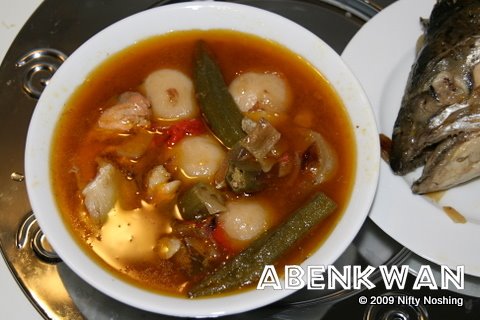
Abenkwan: Ghanaian palm nut soup with foufou

Abenkwan: Ghanaian palm nut soup with foufou recipeGive me head!" I point to a coolbox with freshly cut salmon heads. My fishmonger laughs. "What good is one, take two!" An excellent point. And I am so glad his English is not on the idiomatic level yet.

Even before I get down to cooking, I derive a huge kick from shopping for African ingredients in Brixton Market. Now I only need to buy some garden eggs and okra to fix abenkwan, Ghanaian palm nut soup. It is popular throughout West Africa and known as ngonya mosaka or mbanga in Cameroon, amiedi or obey-ekpo in Nigeria, moambé in the Congo, banga in Sierra Leone and nyembwe in Gabon.


The main ingredient that defines the flavour of abenkwan is palm nut oil. Without the oil you end up with a generic stew. It is squeezed out of boiled fruit of Elaeis guineensis. I go for convenience and buy ready-made one. It is imported from Ghana, so as authentic as it gets.

I have been fascinated with the cuisines of the Cradle of the Humankind ever since I heard a song by a New Yorikan poetess Dana Bryant. It was titled Food, an ode to home-made meals that trace their lineage back to "five thousand years of history on the Nigerian countryside". The tastes and flavours of the places I have never been to, what can be more exciting! So here we go, abenkwan soup with foufou! Yeeppie-ho!

The recipe is simple:
  1. Fry 3 tablespoonfuls of palm nut oil in a pan for about 10 minutes. Traditional recipe calls for a whole cup but here I prefer to give precedence to post-modern health-conscious trends.
  2. Add one chopped onion and one de-seeded chili and fry 10 minutes on medium heat.
  3. Add meat or fish that you use and fry it until fragrant.
  4. Add okra, garden eggs and tomatoes and stir-fry briefly.
  5. Pour cold water until it covers everything and bring to boil. Reduce heat and allow to simmer 10-15 more minutes. The traditional recipe requires a whole day of sitting on hot coals but I think in the olden days it was more about food safety.
  6. Mix foufou flour with water: half a cup flour with 3/4 cup water. Knead well. Make dough balls the size of a regular meat ball. Add to the simmering soup. Cook 5-8 more minutes.
It comes our robust, unctuous and flavourful. Thank you, Mama Afrika!


Here is some nice music to accompany this gorgeous meal:


Sunday, February 15, 2009

African cooking staple: fufu flour

There is no denying: I am crazy. When I discover a new kind of exotic foodstuff I am excited like a child.

The first time I heard the word fufu was in 1996 in a song by a New Yorikan poetess Dana Bryant named Food where she sings and ode to home-made meals tracing their lineage back to "five thousand years of history on the Nigerian countryside". The very name of "egusi soup with fufu" evoked colourful images of what traditional African cooking might be like. But I really had no idea.


My first real life encounter with the cuisine of the Black Continent happened in Bangkok
, which has a sizeable African community. I discovered the delights of West African stews and such delectables as fried ram balls. But they did not serve fufu there.

Here in London, Brixton is home to a variety of Black communities from the Caribbean as well as Africa. You can find any imaginable ingredient, except, perhaps, giant snails that were banned from selling for alleged animal abuse. Here I finally found if not the final product then the main ingredient for fufu. It exists in two versions, plantain (savoury kind of banana) and cocoyam (taro root). I am very excited about fixing fufu at home for the first time.


Friday, February 13, 2009

Afrikan Kitchen Gallery: The Haute Cuisine of Africa

For African restaurants in London African Kitchen Gallery does what Jamie Oliver did to British cuisine taking a hearty if very simple fare of dubious salubrity and turning it into a toe-twirlingly delicious yet healthy extravaganza of tastes and flavours. The result is so amazing I would have to give each dish on their menu a separate detailed description. It is like explaining the cuisine of an extraterrestrial culture so much more advanced culinarily than ours.


Take, for example, one of the starters, moyin moyin which is a sort of bean-and-tomato paté. The amazing thing is that despite it being very herby with the ever so smooth and fluffy texture resembling none of the original ingredients, you palate will instantly recognise what it is made of. Moyin moyin is served with what I would compare to African green pesto, buttery and flavourful.

Or the deliciously flavourful egusi beef stew that I had on my first visit. Served with perfectly cooked - moist yet fluffy - bean rice it was just the right amount of spiciness to underscore, not overpower the tastes of the main components.

The food is so exquisitely delicious that I do suspect there must be some African magic involved but when I think rationally it could be down to their policy of using organic ingredients and nothing artificial. So used are we to the anaemic industrially produced edibles from the supermarkets that the taste of natural and honest food can come as a true revelation.

There are more imagination-sparking items on their menu that will warrant more visits here, like lamb with mango, curried goat stew or wild spinach with melon seeds. I quit being vegetarian years ago but their asaro, yam and sweet potatoes in pepper & tomato sauce, sounds scrumptious.

Three more things I totally dig about this place and probably you will too: one is that it so cosy it feels like dining in somebody's living room richly decorated with African masks and carvings. Two, both proprietors are friendly and always find the time to talk you through the dishes. And last but not least: it is refreshingly affordable for Central London, all main entries are under 10 quid.

Tip: Do try their home-made ginger beer: probably the biggest kick since the invention of processed morphines!


Garden eggs: finally an eggplant that looks like an egg!

What ever can you not find at Brixton Market!

I was planning to cook abenkwan, Ghanaian palm nut soup, that requires garden eggs as an ingredient. I had little idea what they would turn out to be but there you go: for once eggplants that DO look like eggs.

They are called igba or ikan amongst the Yoruba's of Nigeria, it is referred to as ngilo in Swahili and nakasuga or nakati in Uganda, ntroma in Ghana and jiló in Brazil. I saw them in Thailand where they are somewhat smaller and greener and called makhuea pra. I had no idea they had an English name.


Garden eggs